
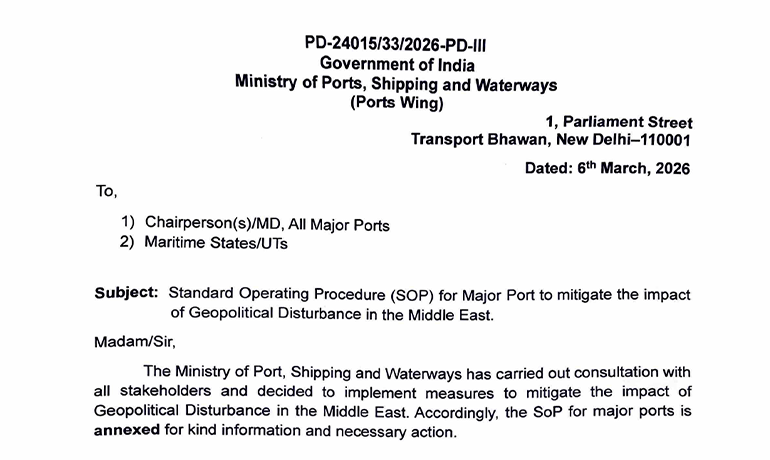
The Government of India, through the Ministry of Ports, Shipping and Waterways, has issued a Standard Operating Procedure (SOP) to address challenges arising from geopolitical disturbances in the Middle East. The objective of this SOP is to ensure smooth port operations, minimize disruption to cargo movement, and support exporters and shipping stakeholders during the crisis period.
SOP on Middle East Disturbance …
Objective
The SOP aims to help major ports manage operational challenges caused by geopolitical disturbances affecting cargo movement to and from the Middle East. It focuses on maintaining operational efficiency, supporting exporters, and ensuring quick coordination between ports and regulatory agencies.
SOP on Middle East Disturbance …
Stakeholder Coordination
Port authorities are instructed to conduct regular meetings with key stakeholders such as shipping lines, exporters, terminal operators, customs authorities, and maritime agencies. These meetings will help monitor the evolving situation and address operational concerns promptly.
SOP on Middle East Disturbance …
Appointment of Nodal Officer
Each port must appoint a Nodal Officer at the level of Head of Department (HOD) or Deputy HOD. This officer will act as the Single Point of Contact (SPOC) for resolving issues related to cargo movement and port operations.
The nodal officer’s contact details, including name, designation, phone number, and email address, must be published on the port’s official website. The officer will be available 24/7 to assist stakeholders and ensure rapid response to operational issues.
SOP on Middle East Disturbance …
Issue Resolution Timeline
The Nodal Officer will coordinate with the appropriate authorities to resolve issues efficiently.
Operational decisions should be taken within 24 hours.
Issues requiring coordination with agencies such as customs (for new storage areas or bonding approvals) must be resolved within 72 hours.
SOP on Middle East Disturbance …
Facilitation Measures by Ports
Ports may implement several facilitation measures to reduce disruption during the crisis:
Cargo Storage
Ports may allow storage of cargo destined for the Middle East as transshipment cargo during the affected period.
Additional Storage Space
If necessary, ports may allocate extra storage areas to manage increased cargo volumes.
Vessel Berthing
Ports may facilitate ad-hoc vessel calls to drop or pick up Middle East-bound cargo.
Back-to-Town Movement
Export cargo that cannot be shipped due to disruptions may be moved back to town quickly in coordination with customs authorities.
Priority Handling
Perishable cargo will receive priority handling to prevent damage or deterioration.
Export cargo returning from the Middle East will also be given priority processing.
Additional Bunkering
Ports may increase bunkering capacity where feasible to support vessels requiring fuel services.
SOP on Middle East Disturbance …
Coordination with Government Agencies
Ports are required to maintain close coordination with agencies such as:
Customs
Directorate General of Foreign Trade (DGFT)
Other regulatory authorities
This coordination will ensure that operational measures are implemented quickly and efficiently.
SOP on Middle East Disturbance …
Relief Measures for Users
Ports may consider requests from port users regarding reduction, waiver, or remission of charges, including:
Reefer container plugging charges
Storage charges
Vessel change charges
These requests will be evaluated on a case-by-case basis, depending on the situation at each port.
SOP on Middle East Disturbance …
Implementation and Monitoring
The SOP becomes effective immediately from the date of issuance and will remain active until withdrawn by the Ministry. The Ministry will continuously review the situation and update the SOP if required.
SOP on Middle East Disturbance …
Ports must also submit a daily action taken report to the Ministry to monitor implementation and ensure timely response to emerging issues.
SOP on Middle East Disturbance …